
Children do not usually become confident, disciplined or organised overnight. These qualities grow through small experiences repeated over time: trying something new, listening carefully, practising a skill, keeping a promise and discovering that effort makes a difference. A positive routine at home, supported by a structured activity such as martial arts, can give children regular opportunities to practise those habits.
Confidence grows through small achievements
Confidence is not simply being the loudest child in the room or always getting things right. It is the growing belief that you can have a go, learn from mistakes and keep trying when something feels difficult.
Children need chances to experience progress for themselves. That might be remembering a sequence, improving their balance, speaking up to ask a question or attempting a movement they found challenging the week before. The achievement does not have to be dramatic. Often, the most meaningful progress is a child recognising, “I couldn’t do that before, but now I can.”
Parents can help by noticing effort as well as outcomes. Instead of only saying “You’re brilliant”, try being specific: “You kept practising even when it was tricky” or “I noticed how carefully you listened today.” This helps children understand which actions contributed to their progress.
Discipline is something children can practise
Discipline is sometimes misunderstood as simply doing what you are told. In a positive learning environment, it is more useful to think of discipline as practising self-control, listening, following through and taking responsibility.
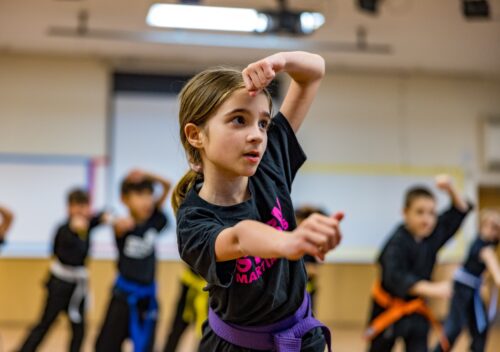
In martial arts, children learn within a clear structure. They listen to instructions, take turns, practise techniques, show respect to training partners and work towards goals. These expectations give them repeated opportunities to practise habits that are useful beyond the training hall.
At home, the same idea can be kept simple. A child might put their shoes away, place their school bag in the same spot or finish a small agreed task before moving on to screen time. The aim is not to make every part of family life rigid. It is to help children understand that being responsible involves small actions they can learn to manage themselves.
Why positive routines make a difference
A routine gives a child a familiar sequence to follow. When the same few steps happen in roughly the same order, children know what is expected and can gradually take more ownership of those steps.
Routines can be particularly helpful around busy parts of the week: getting ready for school, preparing for an activity, completing homework or settling down in the evening. They do not need to be complicated. A short checklist on the fridge or a regular place for important items may be enough to get started.
Try to make routines realistic for your child’s age. A younger child may need a reminder and help with each step, while an older child may be ready to check a list independently. The goal is steady progress towards greater responsibility, not perfection.
Create a simple routine around training
A martial arts class can become a useful anchor in the week. A few predictable steps before and after training can help children arrive prepared and reflect on what they have learned.
- Before class: encourage your child to check that their uniform and any required equipment are ready.
- Allow time: build in enough time to travel and get ready without a last-minute rush.
- After class: ask one positive question, such as “What is one thing you enjoyed learning today?”
- Between classes: if your instructor has suggested something suitable to practise, keep it short and manageable rather than turning it into a long homework session.
- Look ahead: help your child put their next training session into the family calendar so they know what is coming up.
These small habits teach preparation and follow-through. They also give children a chance to talk about their progress without making every journey home feel like a test.
Use encouragement that builds self-belief
Children benefit from knowing that mistakes are part of learning. If a technique does not work first time, resist the urge to step in and solve everything immediately. Give them a moment, offer encouragement and let the instructor guide the next step.
Useful praise is specific and sincere. Recognise when your child has concentrated, shown patience, encouraged a classmate, accepted feedback or tried again after a setback. These are all signs of developing character.
It is also important to avoid comparing siblings, friends or training partners. Children develop at different speeds. A more helpful comparison is with their own previous effort: what can they do now that they found difficult a few weeks ago?
Keep routines positive, flexible and age-appropriate
The best routine is one your family can actually maintain. Start with one small change rather than introducing a long list of new rules. Explain why it matters, agree the steps together and recognise when your child takes responsibility without being reminded.
There will be days when plans change or a routine is missed. That is normal. Simply return to it next time. Consistency matters more than getting every day exactly right, and children should still have time for play, rest and spontaneity.
Developing champions for life at Storm
At Storm Family Martial Arts, our children’s programme is about more than learning martial arts techniques. Through our Developing Champions For Life approach, children are encouraged to develop confidence, character and practical life skills alongside their training. Themes such as respect, teamwork, determination and courage help give children positive ideas to practise in everyday situations.
Our children’s classes include Dragons for ages 4–6 and Tigers for ages 7–12. Within a supportive class environment, children have opportunities to listen, practise, work with others and celebrate their own progress.
If you are looking for a positive activity that can become part of your child’s weekly routine, find out more about children’s martial arts classes at Storm. We welcome families in Maidenhead, Bracknell, Warfield, Twyford and Woodley. You can also explore local information for Maidenhead, Bracknell, Warfield, Twyford and Woodley.
Small steps. Positive habits. Champions for life.